
Monday, June 13, 2011
CARBON CYCLE
Actually I've always believed that carbon, which can also exists as carbon dioxide is bad for the environment. Yes, its true but after my self-learning through ecology(P.S I did this during the hols), the carbon cycle is THE ROOT TO ALL LIFE. This simple cycle ensures that carbon dioxide in the air is always kept constant, not too much, nor too little. During photosynthesis, plants take in carbon dioxide and give out oxygen. The carbon dioxide is turned into complex materials such as sugars, amino acids and stores energy. When the plant is eaten by the autotrophs on the next tropic level, the energy stored in the carbon is passed on to it. The autotrophs releases carbon back to the atmosphere when they are respiring. The feces and animal waste also contains the ingested carbon. Decomposer such as fungi and bacteria feed on them. When the bacteria and fungi respires, carbon dioxide is again released into the atmosphere. When organisms die, decomposition occurs and the same process goes on. By chance, the dead organisms can become fossil fuels or coals. They store tremendous amounts of carbon energy and it is released via combustion. Large amounts of carbon dioxide are released back into the atmosphere. Luckily, the plants take in more carbon dioxide compared to its intake of oxygen and this prevents the level of carbon from getting to high. THE 3 PROCESS THAT IS ESSENTIAL FOR RELEASE OF CARBON IS RESPIRATION, COMBUSTION and DECOMPOSITION. The carbon cycle is important as it transfers energy from one organisms to another as energy are locked up in the carbon. It also ensures that there is enough carbon dioxide in the air for the plants to photosynthesis and ensures that ecosystem, food chain and webs are disrupted. YAY! So next time you are respiring, remember that U are part of the cycle TOO!


Sunday, May 29, 2011
Female Reproductive System
The female reproductive system is a little more complex than that of the male's. This includes the menstrual cycle.

The female gonads are the ovaries. They produce female gametes which are known as eggs or ova. The ovaries contains thousands of eggs but only about 400- 500 become mature in a woman's life. The ovary stops releasing eggs when the woman reaches about 50. This is known as menopause. The ovaries also produce female hormones such as oestrogen and progesterone. The fallopian tubes/oviducts is where fertilization occurs. The uterus/ womb is where the fertilized embryo further develops into a baby. The cervix is expands during childbirth. The vagina is a passage linking the vulva to the cervix. A man's penis enters the vagina during sexual intercourse and deposit sperms there. The sperms can them swim up to the fallopian tube where fertilization occurs.
The Menstrual Cycle

The menstrual cycle usually lasts about 28 days. The first day of menstruation is also the first day of the menstrual cycle. Before we go into this we need to look at the maturation of the eggs in the ovaries. The ovaries contains thousands of eggs or also known as primary follicles. Each month, only one will become mature. The mature egg is known as Graafian Follicle. They will be released from the ovaries and this is known as ovulation.After ovulation, the graafian follicle develops into Corpus Luteum .On the first five days of the menstrual cycle, the uterus lining breaks down.The wastes and bloods are discharged from the uterus in the body through the vagina. The anterior pituitary glands secretes follicle stimulation hormones (FSH). The FSH stimulates the maturation of the hormones. It also stimulates the follicles to secrete oestrogen. From day 6 to 13, the oestrogen helps the uterine lining to recover and build up again. An excess of oestrogen will stop the secretion of FSH w=and prevents more follicles from maturing. The oestrogen makes the pituitary gland secrete LH. The LH allows the graffian follicle to become corpus luteum. The corpus luteum secretes progesterone which helps to maintain the uterus lining for a number of days. If no fertilization occurs, it gradually breaks down.
Friday, May 27, 2011
Reproduction in Humans -- SELF STUDY IN THE JUNE HOLS

When we reach the age of 12-15 we boys start to notice changes in our body. Our reproductive organs get larger. Today, I will be reflecting on what I had learnt about the male reproductive system.
 We
We will start with the testes. The male reproductive system contains two ovules of testes. They produces sperms. The epididymis stores inactive sperms before they are released into the sperm duct. The sperm duct loops over the ureter and opens into the urethra. The Prostate glands, Cowper glands and seminal vesicles releases fluids that contains nutrients and mixes them with the sperms before it is released from the urethra in the penis. This fluid actually activates the sperms. The mixture of sperms and the fluid is called semen.
Anatomy of a Sperm

The head of the sperm contains the nucleus, cell membrane and the acrosome. The acrosome is important as it contains enzymes to break through the cell wall of the female egg cell. The mitochondria produces energy for the sperm to swim to swim towards the egg to fertilise it. The tail or also known as flagellum allows the sperm to swim to the egg cell.
Term 2 Class Test + Reflections

I scored 29 out of 37 in this term's class test. It's a A1, but.... its LOW. I found that I did not revise thoroughly enough. My weaker areas are in Light and chemical equations. Although I spent a lot of effort trying to comprehend and understand how to draw the ray diagrams, I still didn't do well. I also didn't go through the combustion equations and I lost one mark :( I feel that I have troubles answering the light questions and drawing ray diagrams. Majority of the class did very well so I think its time for me to push myself even harder so I could strive for the better in the Term 3 Science Test which is focusing on Biology. With the help of my friends which specializes in Biology, I hope i can score an 80++ in the next test. HERE I COME :)
I also devised a plan and a motto for myself:
Never GIVE UP :)
Friday, March 11, 2011
Quartz Watch
Many of us have heard about quartz crystals keeping time accurate but I was wondering what exactly do these quartz do to keep the watch to maintain its staggering precision?
LET'S START!
Video;
http://www.youtube.com/watch?v=1pM6uD8nePo
Quartz Basic:Quartz is the most common mineral found on Earth. They are transparent or can be known as "crystals" which your mom wears as jewellery since they are nice, attractive and shiny!

Before Quartz
The wind-up watch is an amazing piece of technology itself! It is part of a continuous research-and-development effort that started at the end of the 14th Century. Over the years, different innovations made wind-up watches smaller, thinner, more reliable, more accurate and even self-winding!
The components that you find in today's wind-up watches have been around for centuries:
1)A spring to provide the power
2)Some sort of oscillating mass to provide a timebase
3)Two or more hands
4)An enumerated dial on the face of the watch
5)Gears to slow down from the ticking rate of the oscillating mass and connect the mass and spring to the hands on the dial
Then came the quartz....
There was no problem with the choice of a timing element. The quartz crystal is possibly thousands of times better for timing than the tuning fork, and quartz crystals had been around for many thousands of years. Only the type and the frequency of the crystal needed to be chosen. The difficulty was in the selection of the integrated circuit technology that would function at sufficiently low power.
Quartz crystals have been in regular use for many years to give an accurate frequency for all radio transmitters, radio receivers and computers. Their accuracy comes from an amazing set of coincidences: Quartz -- which is silicon dioxide like most sand -- is unaffected by most solvents and remains crystalline to hundreds of degrees Fahrenheit. The property that makes it an electronic miracle is the fact that, when compressed or bent, it generates a charge or voltage on its surface.(this is why the clock is so accurate!) This is a fairly common phenomenon called the Piezoelectric effect. The electronics of the watch initially amplifies noise at the crystal frequency. This builds or regenerates into oscillation -- it starts the crystal ringing. The output of the watch crystal oscillator is then converted to pulses suitable for the digital circuits, which sends the clock ticking!

In Conclusion:
It works by using the piezoelectric effect: if a small voltage is applied to a specially prepared crystal of quartz it vibrates at a definite and almost constant frequency which can be used to power a tiny motor to turn the hands of the watch.
Read more: http://wiki.answers.com/Q/How_does_a_quartz_watch_work#ixzz1GODFJHzq
Thursday, March 10, 2011
Term 1 Reflections
I fell that I did quite ok for my science test this term. I hope I can score as well as my this test. I made some mistake in Section B for not memorizing the correct formulas:
1)Acid + Bases= Salt + Water
2)Acid + Carbonate= Salt + Carbon Dioxide + Water
3)Acid + Metal= Salt + Hydrogen
Atoms are quite easy to understand.Before test preparation, I suddenly went confused between ionic and covalent bonding and this caused a lot of panic.Luckily, I managed to overcome them. My aim is too get an exemption for exams. Miss Lim is there exemption, my friends says there isn't this year! Even if there is none,I will still try my very best to break my own records. I got 26/40 for last years science test 1 but I broke it this time with 38/40. Though i am already satisfied, but next terms test will be even harder than this.So I must work even harder!But when it comes to acids, bases and salt, I am starting to feel the pressure. I think I am bad in Physics so I must work hard now.
Miss Lim can I see you after the school holidays with Wen Feng? We have got so much questions to ask and we went to the staff room 5 times consecutively for 2 days to find you but you were not there :) Thank You
Post 1 (SUMMARY OF WHAT I'VE LEARNT IN T2 SABBATICAL)
Why use Solar Energy / Renewable sources of energy?
1) Serious depletion of natural resources such as oil, coal and natural gases etc...
Increasing prices of oil, thus electricity usage at home will become more expensive.
2) Environmental problems, huge amount of carbon dioxide emission from the burning of petroleum to produce electricity, toxic gases from cars.


Solar Panel Basics: (To Add on to what I've learnt in Sabbatical)
A solar panel (photovoltaic module or photovoltaic panel) is a packaged interconnected assembly of solar cells, also known as photovoltaic cells. The solar panel can be used as a component of a larger photovoltaic system to generate and supply electricity in commercial and residential applications.
Because a single solar panel can only produce a limited amount of power, many installations contain several panels. This is known as a photovoltaic array. A photovoltaic installation typically includes an array of solar panels, an inverter, batteries and interconnection wiring.
There are mono crystalline solar panels or poly crystalline ones and amorphous. composed of a number of different crystals, fused together to make a single cell (hence the term 'multi'). Monocrystalline, as the name suggests, is constructed using one single crystal, cut from ingots. This gives the solar panel a uniform appearance across the entire module. These large single crystals are exceedingly rare, and the process of 'recrystallising' the cell is more expensive to produce. Amorphous offer better performance in higher temperatures, and have some benefits in shady locations.
Mono Crystalline Solar Panel

( This is very efficient!)
Poly Crystalline Solar Panel

Amorphous Solar Panel
How does a solar panel generate electricity?
You've probably seen calculators with solar cells -- devices that never need batteries and in some cases, don't even have an off button. As long as there's enough light, they seem to work forever. You may also have seen larger solar panels, perhaps on emergency road signs, call boxes, buoys and even in parking lots to power the lights.
Although these larger panels aren't as common as solar-powered calculators, they're out there and not that hard to spot if you know where to look. In fact, photovoltaics -- which were once used almost exclusively in space, powering satellites' electrical systems as far back as 1958 -- are being used more and more in less exotic ways. The technology continues to pop up in new devices all the time, from sunglasses to electric vehicle charging stations. Basically, when light strikes the cell, a certain portion of it is absorbed within the semiconductor material. This means that the energy of the absorbed light is transferred to the semiconductor. The energy knocks electrons loose, allowing them to flow freely and this is electricity!
Diagram:

The Process Of installation::
Survey of site and system design > Product delivery > Roofing work > Installation > System Testing > System Commission
These amazing little things help U to save electricity with the help of the most prehistoric but mandatory source of energy-the light! However, most solar projects normally take roughly 11 to perhaps 20 years for installers to earn back money or to get returns.
Some Big Solar Farms

WELCOME TO THE AGE OF GREEN ENERGY
1) Serious depletion of natural resources such as oil, coal and natural gases etc...
Increasing prices of oil, thus electricity usage at home will become more expensive.
2) Environmental problems, huge amount of carbon dioxide emission from the burning of petroleum to produce electricity, toxic gases from cars.


Solar Panel Basics: (To Add on to what I've learnt in Sabbatical)
A solar panel (photovoltaic module or photovoltaic panel) is a packaged interconnected assembly of solar cells, also known as photovoltaic cells. The solar panel can be used as a component of a larger photovoltaic system to generate and supply electricity in commercial and residential applications.
Because a single solar panel can only produce a limited amount of power, many installations contain several panels. This is known as a photovoltaic array. A photovoltaic installation typically includes an array of solar panels, an inverter, batteries and interconnection wiring.
There are mono crystalline solar panels or poly crystalline ones and amorphous. composed of a number of different crystals, fused together to make a single cell (hence the term 'multi'). Monocrystalline, as the name suggests, is constructed using one single crystal, cut from ingots. This gives the solar panel a uniform appearance across the entire module. These large single crystals are exceedingly rare, and the process of 'recrystallising' the cell is more expensive to produce. Amorphous offer better performance in higher temperatures, and have some benefits in shady locations.
Mono Crystalline Solar Panel

( This is very efficient!)
Poly Crystalline Solar Panel
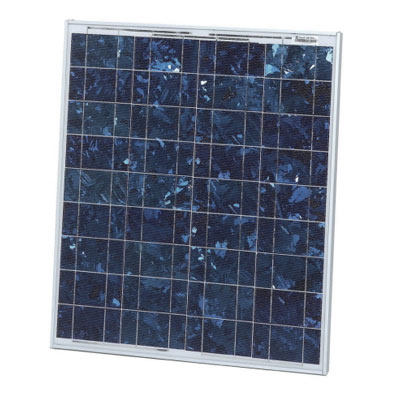
Amorphous Solar Panel
How does a solar panel generate electricity?
You've probably seen calculators with solar cells -- devices that never need batteries and in some cases, don't even have an off button. As long as there's enough light, they seem to work forever. You may also have seen larger solar panels, perhaps on emergency road signs, call boxes, buoys and even in parking lots to power the lights.
Although these larger panels aren't as common as solar-powered calculators, they're out there and not that hard to spot if you know where to look. In fact, photovoltaics -- which were once used almost exclusively in space, powering satellites' electrical systems as far back as 1958 -- are being used more and more in less exotic ways. The technology continues to pop up in new devices all the time, from sunglasses to electric vehicle charging stations. Basically, when light strikes the cell, a certain portion of it is absorbed within the semiconductor material. This means that the energy of the absorbed light is transferred to the semiconductor. The energy knocks electrons loose, allowing them to flow freely and this is electricity!
Diagram:

The Process Of installation::
Survey of site and system design > Product delivery > Roofing work > Installation > System Testing > System Commission
These amazing little things help U to save electricity with the help of the most prehistoric but mandatory source of energy-the light! However, most solar projects normally take roughly 11 to perhaps 20 years for installers to earn back money or to get returns.
Some Big Solar Farms
Subscribe to:
Posts (Atom)